High-Performance E-reader Architecture: Offline-first & Async Processing
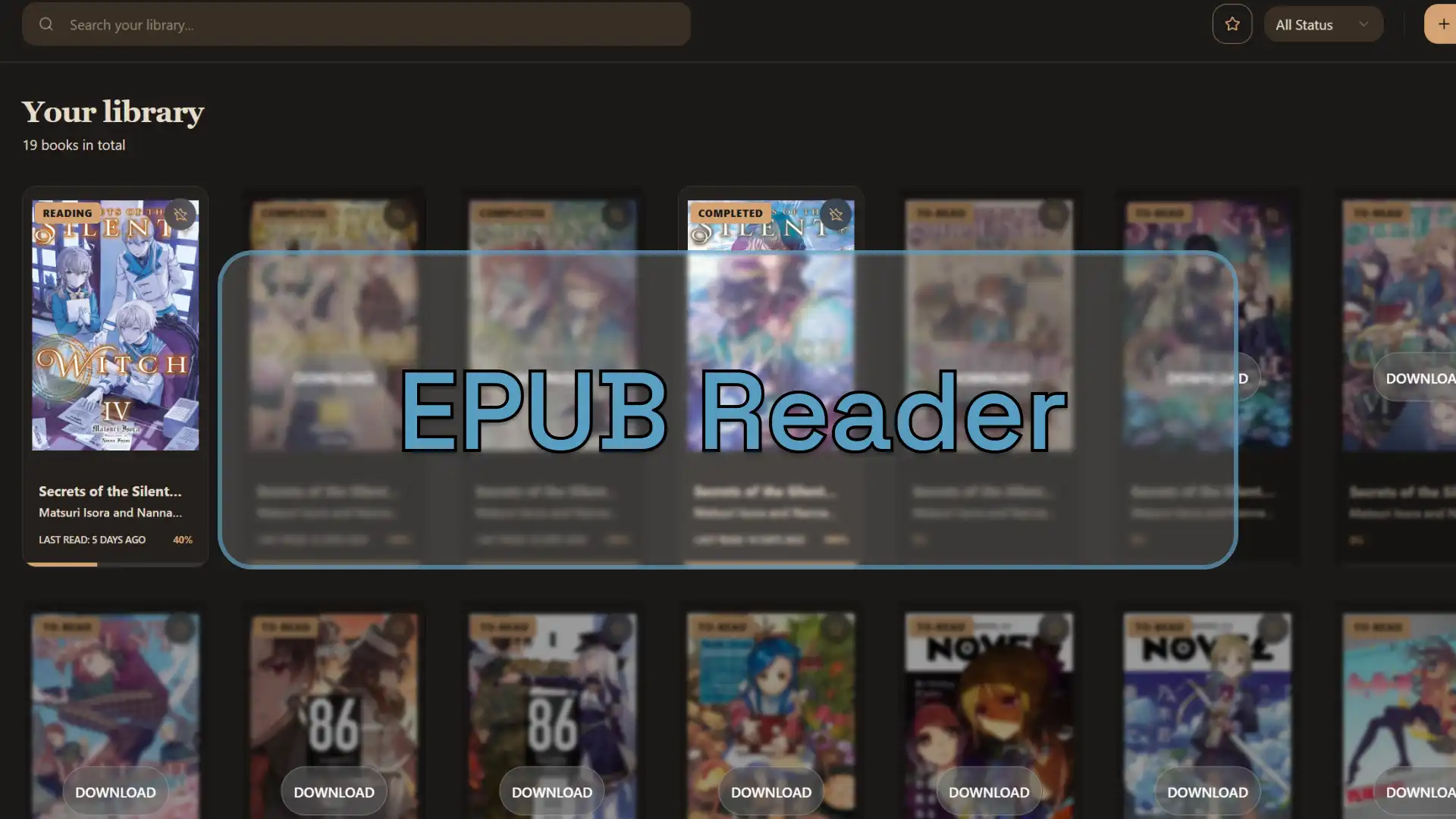
Implementation of an optimized EPUB reader. (Note: Demo backend requires ~30s for cold start on Koyeb).
Tags
Bun, Hono, React, TanStack Query, IndexedDB, Service Workers, TypeScript
Date
February 1, 2026
Links
SourceFrontend Engineering: Decoupling and Persistence
The primary challenge wasn’t just rendering text, but managing the lifecycle of heavy binary files while ensuring a frictionless UI under heavy processing loads.
Binary Management & Web Workers
To prevent main-thread blocking when decompressing and parsing .epub files (which are essentially ZIP containers), I implemented an architecture based on Web Workers.
- Asynchronous Processing: The OCF structure and OPF metadata parsing occur in a separate thread, communicating with the UI via serialized messages.
- JSZip & Stream Processing: Optimized memory consumption when handling large files, preventing browser heap overflows during decompression.
Storage Strategy & Offline-first
Instead of relying on a constant API connection, the system uses IndexedDB as the single source of truth for user content.
- Asset Persistence: Files are stored as
Blobsdirectly in the browser, allowing for near-instant access without re-downloads. - TanStack Query + IndexedDB: I integrated TanStack Query as an abstraction layer over IndexedDB. This leverages its caching, stale-while-revalidate, and declarative state management for loading/error states, even for local data.
Rendering and Resource Interception
- Dynamic Style Injection: Implementation of a theme engine (utilizing OKLCH for precise color spaces) that manipulates the CSS of injected documents without breaking the reader’s encapsulation.
- Service Workers: Interception of internal EPUB resource requests (images, fonts) to serve them directly from local memory, effectively eliminating network latency.
Backend & Security: Robust Infrastructure with Bun and Hono
The backend was designed to be lightweight yet extremely secure, taking advantage of Bun’s speed and Hono’s flexibility.
Authentication Lifecycle
To maintain a secure and persistent session without compromising the user experience, I implemented a token rotation system:
- Refresh Tokens: Stored in
HttpOnlyandSecurecookies to mitigate XSS attacks and maintain long-lived sessions safely. - Short-lived Access Tokens: Used for API authorization with a transparent automatic renewal logic on the client side upon
401responses.
Data Layer and Validation
- Drizzle ORM: Chosen for its minimal overhead and TypeScript-first approach, allowing for type-safe queries that translate almost directly to SQL.
- Strict Validation: Using Zod for contract validation between client and server. I explicitly avoided default values in schemas to prevent conflicts with React Hook Form’s initial states, ensuring total data integrity before persistence.
- Scalability: The system is designed to handle significant user data volume, optimizing book metadata queries to ensure good response times.
Infrastructure & Deployment
The live demo is currently deployed using a cost-optimization strategy:
- Frontend: Deployed on Netlify.
- Backend: Hosted on a Koyeb free instance.
- Note: The demo backend service enters a “sleep” state after inactivity. Please expect a ~30-second cold start delay upon the first request.